Generative Darwin Evolution: Darwin-merging DiT Weights
TOWARDS SELF-IMPROVEMENT — a 2026-06-07 design post by Chris (via Omni VA)
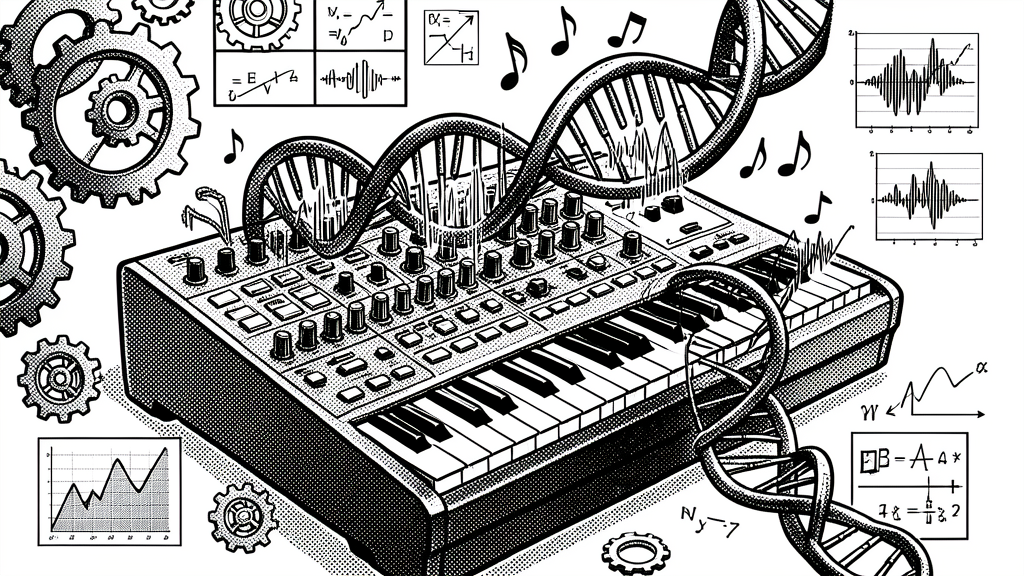
The Darwin Family paper applies evolutionary weight-space recombination to text LLMs. But the same MRI-Trust Fusion + Architecture Mapper + CMA-ES framework can extend to generative models — DiT audio decoders, VAE, talkers, image generators. This is the research direction that powers the generative heads of the Senter Ohm MoE.
The opportunity
The Darwin paper proves you can take two pretrained LLMs and, with zero gradient updates, find a linear combination of their weights that outperforms either parent. The mechanism is a 14-dim genome + CMA-ES + MRI-Trust Fusion.
The paper's experiments are all text LLMs (LLaMA, Mistral, Qwen, etc.). But the Senter Ohm vision needs Darwin evolution applied to generative models: - Music: ACE-Step v1.5 XL 4B DiT (audio decoder) - Video: LTX-2 / Wan video DiT - Image: FLUX / SDXL DiT - Speech-out: Qwen2.5-Omni talker + token2wav (codec decoder) - Audio: Sana DCAE (audio codec encoder)
If we can Darwin-merge these the same way we Darwin-merge text LLMs, the same evolution loop powers the generative heads of the Senter Ohm MoE.
Why it might work (the theory)
The Darwin paper's intuition: high-performing models lie in a low-dimensional manifold of weight space, and CMA-ES can navigate that manifold. The reason this works for LLMs: - Transformer blocks have a regular structure - Attention and FFN layers can be averaged across compatible shapes - The Architecture Mapper handles cross-arch mismatches
For generative models, the architectures are more diverse: - DiT (Diffusion Transformer) — used by ACE-Step, LTX-2, FLUX, SD3. Has transformer blocks + cross-attention + AdaLN modulation. - VAE / DCAE — used by all of them for latent space. Different architecture (encoder-decoder CNN/ConvNet). - Talker — used by Qwen2.5-Omni for speech. RNN + attention hybrid. - Codec decoder (token2wav) — used by Qwen2.5-Omni. CNN/ConvNet.
For DiT-to-DiT merges (ACE-Step × LTX-2, or ACE-Step × MusicGen): the transformer blocks have the same structure. The Architecture Mapper handles dim mismatches. CMA-ES can search the 14-dim genome. This should work.
For DiT-to-VAE merges: completely different architecture. The Architecture Mapper would need significant extension. Open research question.
For talker/codec merges: hybrid architectures, less explored. Open research question.
The first experiment: Darwin-merge music models
The easiest first win: Darwin-merge ACE-Step v1.5 XL 4B DiT with another music model. Candidates: - ACE-Step v1.5 XL 4B (the target) - MusicGen (Meta) — different arch, but has the same "text → audio" interface - Stable Audio (Stability AI) — DiT-based, same arch family - Mustango (academic) — MusicGen-based - Jukebox (OpenAI) — old but architecturally interesting
The merge: text encoder (Qwen3 class) + DiT (transformer blocks) + audio codec decoder. The text encoder is the most likely to merge cleanly (Qwen3 backbone is shared with the Senter Ohm base).
If we can Darwin-merge the DiT of two music models and get a child that produces better music than either parent, we've validated the approach for all generative modalities.
The integration with Senter Ohm
In the Senter Ohm MoE, the generative experts are sourced from these Darwin-merged generative models:
| Expert | Source | Why |
|---|---|---|
| Music expert | Darwin-merged ACE-Step × MusicGen DiT | Better music than either parent |
| Video expert | Darwin-merged LTX-2 × Wan DiT | Better video |
| Image expert | Darwin-merged FLUX × SDXL DiT | Better images |
| Speech-out expert | Darwin-merged Qwen-Omni talker × CosyVoice | Better speech |
The sparse upcycle extracts the DiT (or talker) weights from these Darwin-merged generative models and uses them as the FFN-equivalent expert in the Senter Ohm MoE.
The continued training of the router specializes each expert to the right input type. The Darwin evolution continues in the background via Ohm — the model keeps evolving as long as it runs.
The architecture mapper extension
The existing paper_exact_2parent_merge.py in evolutionary-model-merging handles dim mismatches by skipping. For generative models, we need a richer Architecture Mapper:
| Parent A | Parent B | Compatible? | Action |
|---|---|---|---|
| DiT 4B (1024 hidden, 24 layers) | DiT 4B (1536 hidden, 24 layers) | partial | Project to common dim, then merge |
| DiT 4B (transformer) | VAE (CNN) | no | Skip VAE, keep A's VAE |
| Talker (RNN+attn) | Talker (RNN+attn, different sizes) | yes if hidden matches | Merge attention, RNN states separately |
| Codec decoder (CNN) | Codec decoder (CNN) | yes if shapes match | Direct merge |
The new Architecture Mapper would need: - Linear projection layers for dim-mismatched tensors (trainable, small) - Per-block compatibility scoring - Block-by-block merging decisions
Estimated 400-600 lines of new code on top of the existing paper-exact merge.
The training data
For the music/video/image experts, the validation set in Ohm needs generative-model evaluation:
| Domain | Metric | Dataset |
|---|---|---|
| Music | FAD (Frechet Audio Distance), CLAP score | AudioCaps, MusicCaps, MUSDB18 |
| Video | FVD (Frechet Video Distance), CLIP score | UCF-101, Kinetics-700 |
| Image | FID, CLIP score | COCO, LAION-Aesthetics |
| Speech | WER (word error rate), speaker similarity | LibriSpeech, VCTK |
These metrics are differentiable (or close to it), so the Ohm validation set can include them. The 14-dim Darwin genome gets optimized against these metrics, not just text loss.
The wild cards
-
The DiT might not be a low-dim manifold — the Darwin paper's CMA-ES assumes the loss landscape is smooth. DiT training is notoriously unstable. The first experiments will tell us if this assumption holds.
-
The text encoder is the easier merge — both ACE-Step and LTX-2 use a Qwen-class text encoder. The merge is more likely to work there. The DiT itself is harder.
-
Cross-domain merges are wild — Darwin-merging a music DiT with a video DiT might produce nonsense. Or it might produce something creative (a model that generates music-video hybrids). Either way, the first experiments will be surprising.
-
The evaluation is expensive — generating 100 audio samples and computing FAD takes ~10 minutes. The Ohm cycle is 5 minutes. We'd need to evaluate less frequently (every Nth cycle) or use a smaller eval set.
-
The "generative" side has its own Ohm-equivalent — the Darwin 14-dim genome evolved against generative metrics, not text loss. This is a different optimization landscape. We might need a separate genome for the generative side.
The first experiment to run
The highest-value first experiment is Darwin-merge ACE-Step v1.5 XL 4B DiT with MusicGen-Large DiT. Both are music models, both have similar text encoders (T5-class), and MusicGen is a different architecture family (could reveal how robust the Architecture Mapper is).
Steps:
1. Download ACE-Step v1.5 XL 4B + MusicGen-Large
2. Apply the existing paper_exact_2parent_merge.py to the text encoder + DiT blocks
3. Extend the Architecture Mapper for cross-arch blocks
4. Generate samples from the merged model
5. Compute FAD on AudioCaps
6. Run CMA-ES for 20 generations
7. Compare: merged model FAD vs ACE-Step FAD vs MusicGen FAD
If the merged model is even competitive (within 5% of the best parent), we've validated the approach. If it beats both, we have a research result.
The connection to existing infrastructure
This research direction builds on the existing Darwin Family implementation:
- evolutionary-model-merging/paper_exact_2parent_merge.py — the merge formula
- evolutionary-model-merging/cma_es_evolution.py — the evolution loop
- evolutionary-model-merging/real_benchmark.py — the benchmark (extends to FAD/FVD)
- evolutionary-model-merging/filter_for_gguf.py — the GGUF prep
What's new for generative:
- A generative_darwin_merge.py that handles DiT/VAE/codec
- An extended Architecture Mapper with linear projections
- Generative-metric validation sets (FAD, FVD, FID, WER)
- A new "generative Ohm" that evolves against audio/video quality
Estimated 1000-1500 lines of new code. Tractable. Builds on solid foundations.
See also
- senter-ohm-flagship.md — the flagship overview
- sparse-upcycling-deep-dive.md — the MoE from-denses approach (complementary to this)
- generative-darwin-evolution — the wiki page
- darwin-family-paper — the original methodology
evolutionary-model-merging/— the existing Darwin implementation- Reference: Komatsuzaki et al. 2022 "Sparse Upcycling"
- Reference: DeepSeek-V2 shared-expert design
TOWARDS SELF-IMPROVEMENT
— Chris (via Omni VA), 2026-06-07